







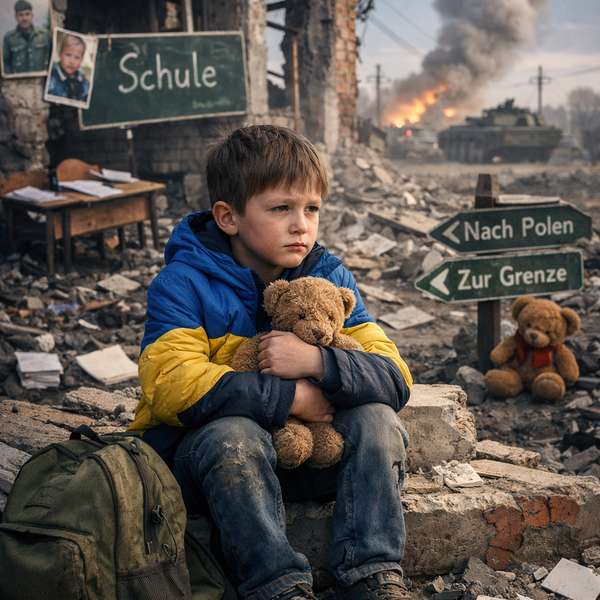
Four years after the start of the Russian invasion, the situation for children in Ukraine remains dire. International aid organizations are sounding the alarm, warning of long-term psychological, social, and educational damage. Organizations operating in Germany also see the danger that an entire generation will be permanently affected.
Daily life without stability: Psychological stress and interrupted education
According to World Vision Germany, a structured daily routine is hardly possible for many Ukrainian children anymore. Co-chair Janine Lietmeyer explained on Deutschlandfunk radio that air raid sirens, power outages, and repeated displacement regularly disrupt school attendance.
Added to this is the constant fear for family members, especially fathers and older siblings fighting on the front lines. Many children suffer from emotional stress and insecurity.
UNICEF also reports devastating losses: Since the start of the war, one in five children in Ukraine has lost a close relative or friend. In addition to grief, unstable living conditions are further exacerbating the situation.
Lietmeyer also emphasized that the willingness to donate in Germany remains high. At the same time, however, increasing „donation fatigue“ is being observed – a phenomenon confirmed by other aid organizations in the country. Faced with rising living costs and other global crises, many donors are confronted with difficult decisions.
Abduction and flight: Thousands of children affected
The humanitarian situation remains critical for other reasons as well. According to Ukrainian government figures, around 20,000 children have been trafficked to Russia since 2014 and, among other things, put up for adoption there.
The Humanitarian Research Lab at a US university claims to have identified more than 8,400 children who were deliberately taken to facilities in Russia and, in some cases, Belarus. By March 2025, only slightly more than 1,200 of them had returned to Ukraine.
At the same time, millions of children remain displaced. According to UNICEF, around 2.6 million minors are considered internally displaced. Almost 1.8 million have fled abroad – many to Poland, Germany, and other European countries. Since 2022, Germany has been one of the most important host countries for Ukrainian war refugees. More than 791,000 children are internally displaced within Ukraine.
A recent UNICEF survey also shows that one-third of young people between the ages of 15 and 19 have had to flee at least twice. The main reason is ongoing security risks due to fighting and rocket attacks.
Dead, injured, and destroyed schools
Besides displacement and forced migration, direct violence remains a major problem. According to UNICEF, more than 3,200 children have been killed or injured since February 2022. The number of victims has recently risen again. Experts also assume a high number of unreported cases, as many incidents cannot be fully documented.
The education system has also been severely affected. More than 1,700 schools and other educational institutions have been damaged or completely destroyed. As a result, approximately one in three children is unable to attend in-person classes regularly.
To maintain instruction, aid organizations are increasingly relying on digital learning resources. Online classes and mobile education programs are intended to prevent children from falling permanently behind.
Fear of a „lost generation“
Aid organizations are issuing urgent warnings about long-term consequences. Four years of war could negatively impact the development of an entire generation.
UNICEF is therefore calling for a significant increase in international aid. Around US$350 million in humanitarian assistance is needed for the current year. So far, however, this sum is significantly underfunded.
From a European perspective, the situation remains of particular importance. Beyond the humanitarian responsibility, the war also has direct repercussions for education systems, integration policies, and social structures in countries like Germany, which have taken in many Ukrainian families.
Conclusion
Four years after the start of the war, the situation for Ukrainian children remains alarming. Displacement, violence, psychological trauma, and disrupted education characterize their daily lives. Aid organizations warn of long-term consequences and call for continued international support to prevent an entire generation from having to bear the lasting effects of the war.

Judith Hermann berichtet für Kulturpoebel.de über aktuelle Themen aus Nachrichten, Politik, Wirtschaft, Technologie, Sport, Unterhaltung und Lifestyle. Ihr Schwerpunkt liegt auf klarer Berichterstattung, relevanten Informationen und aktuellen Entwicklungen, die Leserinnen und Leser zuverlässig und verständlich informieren.











+ There are no comments
Add yours