






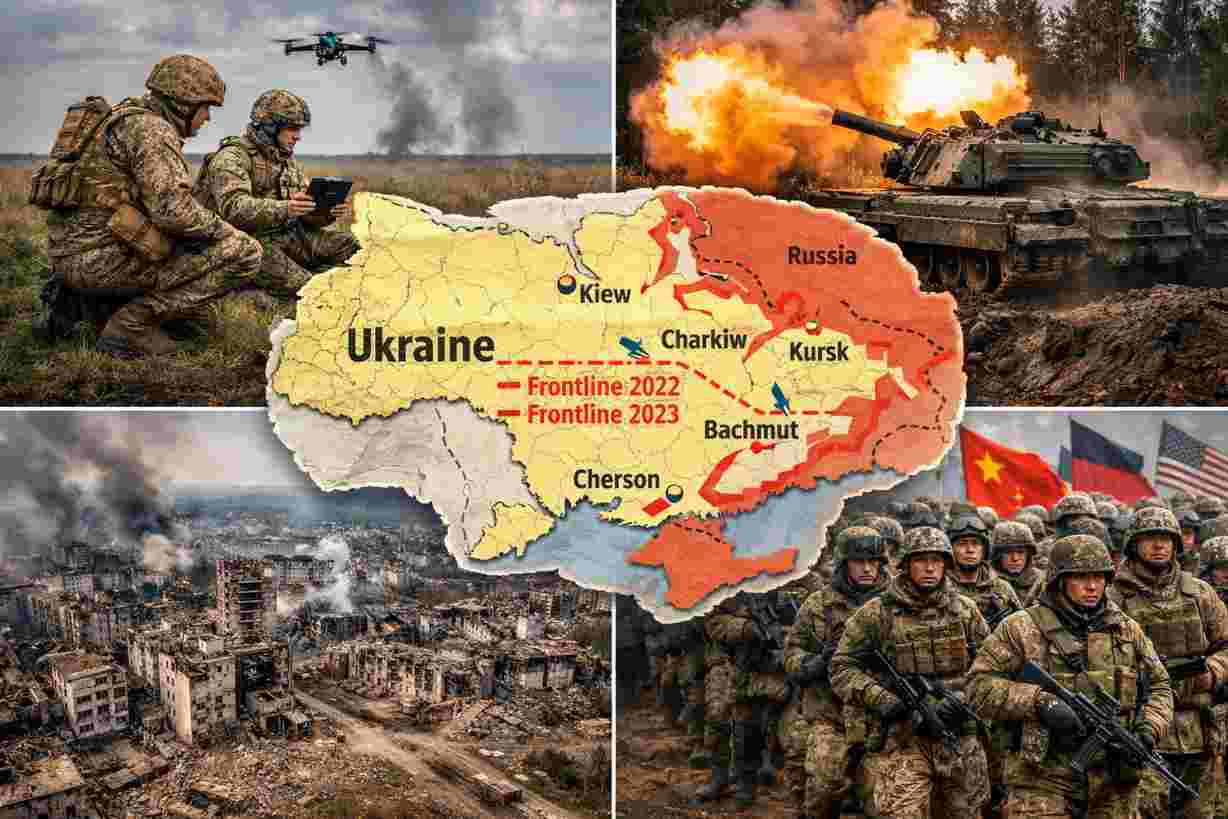
The Russian attack on Ukraine has fundamentally shaped the security situation in Europe for the past four years. In Germany, too, the war has had a lasting impact on political debates about defense spending, energy supply, and the role of the Bundeswehr (German Armed Forces). While Russia initially made significant territorial gains, the conflict increasingly developed into a costly war of attrition with only minor shifts in the front line.
2022: Failed lightning attack and first Ukrainian successes
On February 24, 2022, Russian President Vladimir Putin ordered a large-scale invasion of Ukraine. The apparent goal was a swift change of power in Kyiv. However, this plan failed within a few weeks.
Ukrainian troops were able to push Russian units back from the suburbs of the capital. The massacres of civilians in Bucha, in particular, sparked international outrage and also strengthened political support for Ukraine in Germany.
At the same time, Russia achieved military successes in the south and east. The port city of Mariupol was completely destroyed after a months-long siege. Ukrainian soldiers who had barricaded themselves in the Azovstal steelworks surrendered on the orders of President Volodymyr Zelenskyy.
Ukrainian counter-offensives in autumn
In the fall of 2022, Ukraine launched a surprisingly successful counter-offensive. Large parts of the Kharkiv region were recaptured. The strategically important city of Kherson also fell back under Ukrainian control. These were Ukraine’s last major territorial gains to date.
2022 to 2023: Bachmut and the transition to trench warfare
The Battle of Bakhmut became the bloodiest of the entire war. Russian troops and mercenaries attacked Ukrainian positions for months.
In May 2023, the last Ukrainian units withdrew. The city was almost completely destroyed. Militarily, Bakhmut marked the transition from a war of movement to a war of attrition with more stable front lines.
2023: Failed offensive and new role of drones
The Ukrainian summer offensive of 2023 did not bring the hoped-for breakthrough. Russian units had established deep defensive lines.
At the same time, the massive use of drones fundamentally changed warfare. Large troop movements became increasingly risky, as they could be quickly detected and attacked.
Since 2024: Technological warfare and new strategies
From 2024 onwards, Russia increasingly relied on smaller, mobile units. Precision weapons, electronic warfare, and drones increasingly dominated combat.
The US journal Foreign Affairs describes the conflict as a technologically driven war of attrition, in which reconnaissance and targeted attacks are crucial.
Fighting on Russian territory
In August 2024, Ukraine attacked the Russian region of Kursk for the first time. The aim was to reduce pressure on the border region of Sumy.
Russia was also supported by North Korean soldiers. Only after US President Donald Trump temporarily suspended the sharing of intelligence data in March 2025 was Russia able to regain control of the territory.
2025: High losses and minimal ground gains
Russia made only minor territorial gains in 2025, while suffering heavy losses. Both sides are increasingly using drones, which has led to so-called death zones along the front line expanding to a width of up to 40 kilometers.
According to an analysis by Foreign Affairs, the year was marked by limited military success for Russia.
2026: Starlink outage brings short-term benefits to Ukraine
In early 2026, Elon Musk’s Starlink satellite system blocked access for Russian forces. This allowed Ukraine to temporarily recapture several dozen square kilometers.
However, these territorial gains are considered tactically limited and not strategically decisive.
Overall result: Heavy losses, hardly any movement
According to the Reuters news agency, Russia has only been able to occupy about 1.3 percent of additional Ukrainian territory since the beginning of 2023.
The think tank Center for Strategic and International Studies estimates that Russia has lost around 1.2 million soldiers since the start of the war – including those killed, wounded and missing.
Ukrainian losses are therefore significantly lower, but still remain substantial.
Conclusion: A war without a quick decision
Four years after the start of the invasion, neither side is close to a clear military victory. The conflict has developed into a protracted war of attrition, the outcome of which remains uncertain.
For Germany and Europe, war remains a key security policy factor – with long-term consequences for defense, the economy and stability on the continent.

Judith Hermann berichtet für Kulturpoebel.de über aktuelle Themen aus Nachrichten, Politik, Wirtschaft, Technologie, Sport, Unterhaltung und Lifestyle. Ihr Schwerpunkt liegt auf klarer Berichterstattung, relevanten Informationen und aktuellen Entwicklungen, die Leserinnen und Leser zuverlässig und verständlich informieren.









+ There are no comments
Add yours